
North America Industrial Hose and Gasket Manufacturer
Klingersil C-7400 Gasket Sheet Material | Flow Components
Sheet Good Materials
Thermoseal Klingersil C-7400 satisfies both sealing and electrical requirements. C-7400 is resistant to moderate caustics and acids which makes it suitable for paper mills. It can also act as an insulator or barrier to the flow of electrons from one flange to another due to its high dielectric strength.
This material is manufactured with synthetic fiber reinforced with an EPDM binder.
- Creep relaxation ASTM F38B : 20%
- Sealability ASTM F37A (1/32″) : <0.01 ml/h
- Gas Permeability DIN 3535/6 : < 0.5 ml/min
- Compressibility ASTM F36J: 7– 17 %
- Recovery ASTM F36J : 50 % minimum
KLINGER Hot Compression Test
- Thickness Decrease 73°F (23°C): 15 % initial
- Thickness Decrease 572°F (23°C) : 15 % additional
- Weight increase ASTM F146 after immersion in
- Fuel B, 5h/73°F (23°C) : 15 % maximum
- Thickness Increase ASTM F146 after immersion in
- ASTM Oil IRM 901, 5h/300°F (149°C) : 0 – 5 %
- ASTM Oil IRM 903, 5h/300°F (149°C) : 15 – 30%
- ASTM Fuel A, 5h/73°F (23°C) : 0 – 20%
- ASTM Fuel B, 5h/73°F (23°C): 5 – 20%
- Dielectric Strength ASTM D149-95a : 22 kV/mm
- Density ASTM F1315 : 94 lb/ft ³ (1.5 g/cc ³)
- Leachable Chloride Content FSA Method : 200 ppm
- ASTM F104 Line Call Out : F712121B3E11K6M5
- Color: Gray/White
The pressure/temperature graphs shown are the most current method of determining the suitability of a gasket material in a known environment. However, chemical compatibility must also be considered.
pT diagram for thickness 1/16":
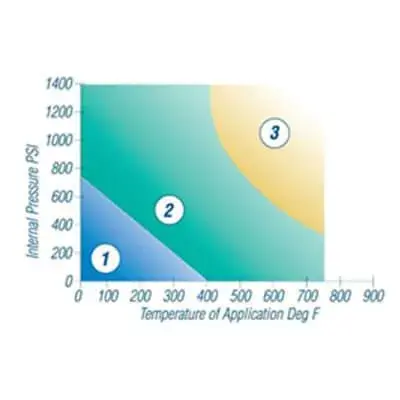
Liquids
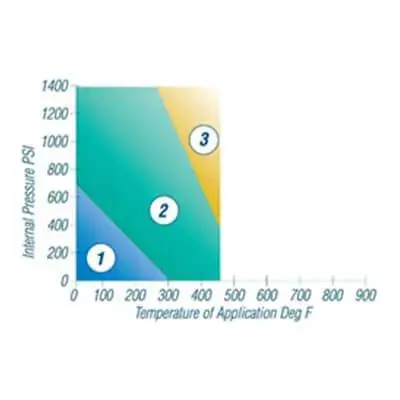
Gases & Steam
In area 1
the gasket material is suitable using common installment practices subject to chemical compatibility
In area 2
appropriate measures are necessary for installation of the gasket to ensure maximum performance. Please call or refer to KLINGER expert for assistance.
In area 2
do not install gaskets in these applications without first referring to KLINGER expert or contacting KLINGER Thermoseal’s technical support service